|
General Specifications
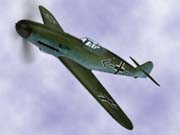
- Wingspan: 9.92 m (32 ft. 6 ½ in.)
- Length: 8.85 m (29 ft. 8 in.)
- Height: 2.50 m (8 ft. 2 in.)
- Weight: 2,253 kg. (4,968 lb.)
- Engine: Daimler Benz DB605A
- Horsepower: 1,475 hp
- Guns: One 20 mm cannon and two 13 mm machine guns
___________________________________________________________
When Willy Messerschmitt's first successful fighter design for the Luftwaffe flew in September of 1935, no one could anticipate that this would be one of the most successful fighter planes of all time. Before its operational career was completed, over 35,000 examples would be produced in several countries, and it would equip the front-line squadrons of a dozen nations. It was produced for nearly 25 years and could be found in operational service until the mid-1960s.
Additionally, the Bf-109 sounded the death knell for the biplane fighter era, ringing in a new era of technology. In a single package, the 109 brought German pilots retractable landing gear, enclosed cockpits, radio communication, and cannon armament that forever changed the nature of air combat. Its particular strengths and weaknesses created the need for new tactical doctrines and formations, and for the first time in air fighting, teamwork became an essential part of air combat. The 109s were sent to the Spanish Civil War in 1937, where brilliant Luftwaffe tacticians like Werner Moelders and Adolph Galland crafted the tactical doctrines of the Rotte (fighting pairs) and the Schwarm (finger-four formations) to take full advantage of the 109's superiority. The Allies, out of necessity, later adopted these tactics to combat the 109s in the air.
The G model, or Gustav, as the Luftwaffe affectionately knew it, was a development of the earlier F model (Franz), which represented the pinnacle of the 109's maneuverability. From this point on heavier armament and engines would sap the 109's ability to turn. The heavier Daimler Benz DB 605 engine gave the Gustav 275 additional horsepower that raised the top speed to 406 m.p.h. but hampered its ability to maneuver against the nimble Spitfire. The Gustav represented the bulk of the 109s produced and could be found in every theater of operations that the Germans contested.
Though it was intended as a stopgap until more advanced fighters could be introduced, the Gustav continued to soldier on until the war's end. With it, the Luftwaffe pilots wrote a story of combat achievement unique in the annals of aviation history.
|